[Spring Security] 스프링 시큐리티 인증·인가 구성 및 UserDetailsService 구현 정리
Spring Security의 HTTP 보안 설정(HttpSecurity)과 주요 인가 메서드, 4가지 사용자 저장소(In-Memory, JDBC, LDAP, 커스텀 UserDetailsService) 구성 방법, 그리고 BCrypt PasswordEncoder 적용법을 정리합니다.
Spring Security 기본 구성 (SecurityConfig)
Spring Security 의존성을 추가하면 모든 HTTP 요청에 대해 기본 인증 필터 체인이 동작합니다. 과거 Spring Boot 2.x 기반에서는 WebSecurityConfigurerAdapter를 상속해 configure() 메서드를 오버라이드하여 웹 보안 정책과 사용자 인증 방식을 구성했습니다.
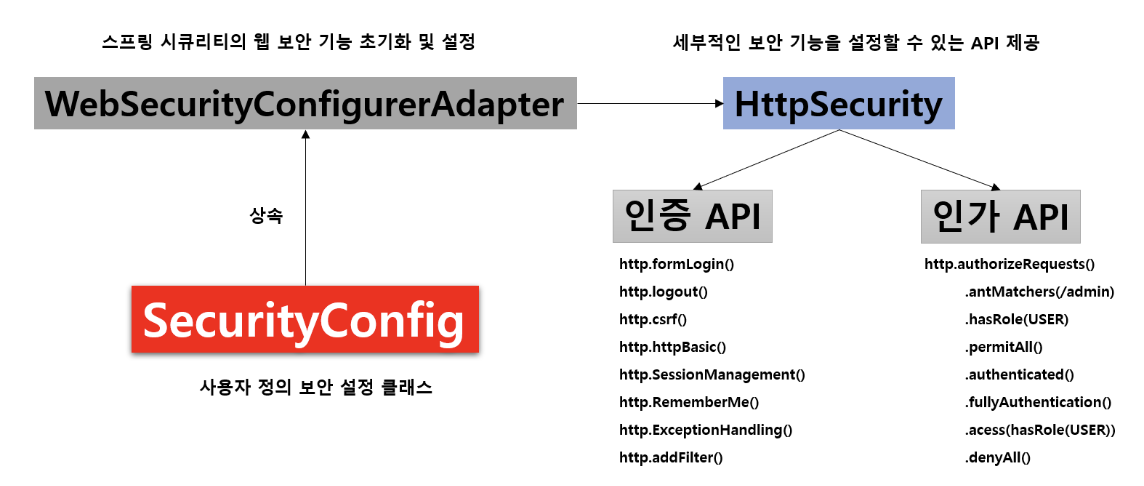
최신 버전 참고 (Spring Security 5.7+ / Spring Boot 3.x):
현재는WebSecurityConfigurerAdapter가 deprecated 되었으며,SecurityFilterChain을@Bean으로 등록하는 컴포넌트 기반 설정 방식이 표준입니다. 다만 내부 인가 메서드(authorizeHttpRequests,formLogin,UserDetailsService,PasswordEncoder)의 핵심 개념은 동일합니다.
@Configuration
@EnableWebSecurity
@RequiredArgsConstructor
public class SecurityConfig extends WebSecurityConfigurerAdapter {

    private final UserDetailsService userDetailsService;

    @Bean
    public PasswordEncoder encoder() {
        return new BCryptPasswordEncoder();
    }

    @Override
    protected void configure(HttpSecurity http) throws Exception {
        http
            .authorizeRequests()
                .antMatchers("/design", "/orders").hasRole("USER")
                .antMatchers("/", "/**").permitAll()
            .and()
                .formLogin()
                .loginPage("/login")
            .and()
                .logout()
                .logoutSuccessUrl("/")
            .and()
                .csrf();
    }

    @Override
    protected void configure(AuthenticationManagerBuilder auth) throws Exception {
        auth
            .userDetailsService(userDetailsService)
            .passwordEncoder(encoder());
    }
}
주요 HTTP 인가 메서드 및 SpEL 표현식 정리
| 메서드 / SpEL 표현식 | 설명 |
|---|---|
permitAll() |
인증 여부와 무관하게 무조건 접근 허용 |
denyAll() |
무조건 접근 거부 |
anonymous() / isAnonymous() |
익명 사용자(미인증 사용자)에게만 접근 허용 |
authenticated() / isAuthenticated() |
로그인으로 인증된 사용자에게 접근 허용 |
fullyAuthenticated() / isFullyAuthenticated() |
remember-me 자동 로그인이 아닌 직접 인증된 사용자에게만 허용 |
rememberMe() / isRememberMe() |
remember-me 쿠키를 통해 자동 인증된 사용자에게 허용 |
hasRole(String) |
지정된 역할(자동 ROLE_ 접두사 포함)을 가진 사용자에게 허용 |
hasAnyRole(String...) |
나열된 역할 중 하나라도 가지면 허용 |
hasAuthority(String) |
접두사 추가 없이 지정된 정확한 권한 문자열을 가진 사용자에게 허용 |
hasAnyAuthority(String...) |
나열된 권한 중 하나라도 가지면 허용 |
hasIpAddress(String) |
지정된 IP 대역에서 온 요청일 때만 허용 |
access(String) |
인자로 전달한 SpEL 표현식이 true일 때 접근 허용 (예: hasRole('USER') and isFullyAuthenticated()) |
사용자 스토어(User Store) 구성 4가지 방식
Spring Security는 인증에 사용할 사용자 정보를 어디서 가져올지 크게 4가지 방식으로 구성할 수 있습니다.
- In-Memory 기반 (테스트 및 고정 계정용)
- JDBC 기반 (표준 RDBMS 쿼리 방식)
- LDAP 기반 (사내 디렉토리 서버 연동용)
- 커스텀
UserDetailsService(JPA 엔티티 연동 — 실무 표준)
1. In-Memory 기반
변경이 필요 없는 소수의 테스트 계정을 메모리에 올려둘 때 사용합니다.
@Override
protected void configure(AuthenticationManagerBuilder auth) throws Exception {
    auth
        .inMemoryAuthentication()
        .withUser("admin").password("{noop}1234").authorities("ADMIN")
        .and()
        .withUser("testuser").password("{noop}1234").authorities("USER");
}
2. JDBC 기반
RDBMS 테이블에 저장된 사용자 정보를 SQL로 직접 조회합니다. 기본적으로 username을 조건으로 사용자(username, password, enabled), 권한(username, authority), 그룹을 조회하며 커스텀 SQL 지정도 가능합니다.
@Override
protected void configure(AuthenticationManagerBuilder auth) throws Exception {
    auth.jdbcAuthentication()
        .dataSource(dataSource)
        .usersByUsernameQuery("""
                select username, password, enabled
                from users
                where username = ?
                """)
        .authoritiesByUsernameQuery("""
                select username, authority
                from authorities
                where username = ?
                """)
        .passwordEncoder(encoder());
}
3. LDAP 기반
**LDAP(Lightweight Directory Access Protocol)**는 네트워크상 디렉토리 서비스 표준(X.500 DAP)을 TCP/IP 기반으로 경량화한 트리 구조 저장·인증 프로토콜입니다. 주로 사내 통합 계정 관리 환경에서 사용됩니다. (참고: LDAP 개념 정리)
@Override
protected void configure(AuthenticationManagerBuilder auth) throws Exception {
    auth.ldapAuthentication()
        .userSearchBase("ou=people")
        .userSearchFilter("(uid={0})")
        .groupSearchBase("ou=groups")
        .groupSearchFilter("member={0}")
        .contextSource()
            .root("dc=taco,dc=com")
            .ldif("classpath:users.ldif")
        .and()
        .passwordCompare()
            .passwordEncoder(new BCryptPasswordEncoder())
            .passwordAttribute("userPasscode");
}
4. 커스텀 UserDetailsService 구현 (JPA 연동)
실무에서는 JPA 엔티티가 UserDetails를 구현하거나 별도의 어댑터 클래스를 두고, UserDetailsService를 구현해 DB에서 회원을 조회하는 방식을 사용합니다.
UserDetails 인터페이스 주요 메서드
| 메서드명 | 리턴 타입 | 설명 |
|---|---|---|
getAuthorities() |
Collection<? extends GrantedAuthority> |
계정이 가진 권한 목록 반환 |
getPassword() |
String |
암호화된 비밀번호 반환 |
getUsername() |
String |
사용자 로그인 식별자(ID) 반환 |
isAccountNonExpired() |
boolean |
계정 만료 여부 (true: 만료되지 않음) |
isAccountNonLocked() |
boolean |
계정 잠금 여부 (true: 잠기지 않음) |
isCredentialsNonExpired() |
boolean |
비밀번호 만료 여부 (true: 만료되지 않음) |
isEnabled() |
boolean |
계정 활성화 여부 (true: 사용 가능) |
엔티티 · 리포지토리 · 서비스 · 회원가입 컨트롤러 예시
@Entity
@Data
@NoArgsConstructor(access = AccessLevel.PUBLIC, force = true)
@RequiredArgsConstructor
public class User implements UserDetails {
    private static final long serialVersionUID = 1L;

    @Id
    @GeneratedValue(strategy = GenerationType.AUTO)
    private Long id;

    private final String username;
    private final String password;
    private final String fullname;
    private final String street;
    private final String city;
    private final String state;
    private final String zip;
    private final String phoneNumber;

    @Override
    public Collection<? extends GrantedAuthority> getAuthorities() {
        return Arrays.asList(new SimpleGrantedAuthority("ROLE_USER"));
    }

    @Override public boolean isAccountNonExpired() { return true; }
    @Override public boolean isAccountNonLocked() { return true; }
    @Override public boolean isCredentialsNonExpired() { return true; }
    @Override public boolean isEnabled() { return true; }
}
@Repository
public interface UserRepository extends JpaRepository<User, Long> {
    User findByUsername(String username);
}

@Service
@RequiredArgsConstructor
public class UserRepositoryUserDetailsService implements UserDetailsService {

    private final UserRepository userRepo;

    @Override
    public UserDetails loadUserByUsername(String username) throws UsernameNotFoundException {
        User user = userRepo.findByUsername(username);
        if (user != null) {
            return user;
        }
        throw new UsernameNotFoundException("User '" + username + "' not found");
    }
}
@Data
public class RegistrationForm {
    private String username;
    private String password;
    private String fullname;
    private String street;
    private String city;
    private String state;
    private String zip;
    private String phone;

    public User toUser(PasswordEncoder passwordEncoder) {
        return new User(
            username,
            passwordEncoder.encode(password),
            fullname, street, city, state, zip, phone
        );
    }
}

@Controller
@RequestMapping("/register")
@RequiredArgsConstructor
public class RegistrationController {

    private final UserRepository userRepo;
    private final PasswordEncoder passwordEncoder;

    @GetMapping
    public String registerForm() {
        return "registration";
    }

    @PostMapping
    public String processRegistration(RegistrationForm form) {
        userRepo.save(form.toUser(passwordEncoder));
        return "redirect:/login";
    }
}
PasswordEncoder (비밀번호 단방향 해싱)
Spring Security 5부터는 보안을 위해 PasswordEncoder를 통한 비밀번호 암호화가 의무화되었습니다. 회원가입 시 반드시 encode()로 해싱해 저장해야 하며, 로그인 시에는 내부적으로 matches(rawPwd, encodedPwd)로 일치 여부를 검증합니다.
실제로 BCryptPasswordEncoder로 저장된 DB 레코드는 다음과 같이 솔트(Salt)가 적용된 해시 문자열로 저장됩니다.
| ID | USERNAME | PASSWORD (BCrypt 해시) | FULLNAME | CITY |
|---|---|---|---|---|
1 |
user |
$2a$10$GtCiKop4o9Vlm7CoKryHCuXVehCyNYB5krnMJBbfOylkVInzinc7K |
user |
aaa |
Spring Security 제공 주요 PasswordEncoder 구현체
BCryptPasswordEncoder: 가장 널리 쓰이는 BCrypt 해싱 (강력한 단방향 + 랜덤 Salt 내장)Pbkdf2PasswordEncoder: PBKDF2 알고리즘 기반 암호화SCryptPasswordEncoder: scrypt 해싱NoOpPasswordEncoder: 암호화 미적용 (deprecated, 테스트 외 사용 금지)
[Spring Security] hasRole("ROLE_USER") 오류 원인과 ROLE_ Prefix 동작 원리
NEXT LOG →[Spring] YAML(YML) 문법과 Spring Boot 설정(@ConfigurationProperties, Profile) 정리